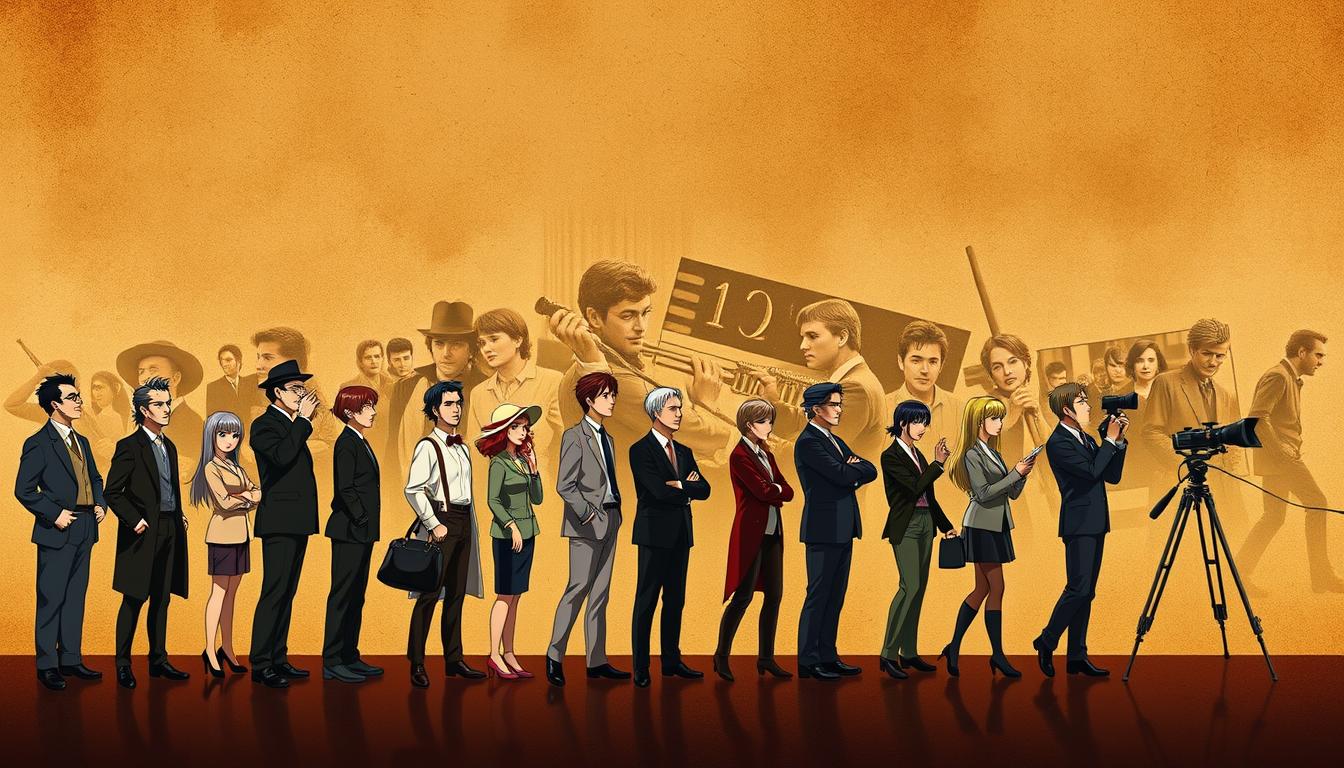
Acting has a long history, starting in ancient Greece and Renaissance Italy. It entered film history over 150 years ago with pioneers like George Eastman and the Lumière brothers1. Today, acting styles keep changing, from silent pantomime to CGI-driven blockbusters.
In the 1920s, Hollywood’s studio system controlled actors like Douglas Fairbanks and Charlie Chaplin2. Back then, silent comedies and Westerns were big, while today, action movies and superhero films top the charts2. This change shows how acting moved from physical comedy to more complex performances.
Big changes came in 1927 with The Jazz Singer, which added sound to films1. Today, stars like Scarlett Johansson and Dwayne Johnson mix blockbuster hits with serious roles2. Film history shows how acting evolves with new technology, from silent slapstick to AI-driven de-aging.
Key Takeaways
- Acting roots trace to 534 BC Greece and 16th century Italy
- 1920s studio systems forced strict film quotas for actors2
- Sound films like The Jazz Singer (1927) changed performance techniques1
- Modern actors use CGI and global franchises, mirroring past innovators like Greta Garbo2
- Netflix’s 371 2019 originals show today’s decentralized film landscape1
The Birth of Film Acting: Silent Era Expressions
Early film history shows how silent films used body language to tell stories. Actors made big gestures and showed their feelings on their faces. This was because they didn’t have dialogue to help tell the story.
Actors from the stage found it hard to adjust to film. Over 60% of silent films were shot with Pathé cameras. These cameras were big and made it hard to move around on set3. But stars like Charlie Chaplin and Buster Keaton changed everything. They used their bodies and faces in amazing ways.
Chaplin’s character was known for his funny and precise movements. Keaton, on the other hand, was famous for his serious face and ability to make falling look like art. They showed us how to connect with people through just looking and moving4.
“The sooner the stage people who came into pictures get out, the better for the pictures.”
Stage actors found it tough to switch to film. But Chaplin and Keaton showed us how to do it right. They used pantomime and timing to make us feel what they were feeling4.
- Close-ups: Framing focused on actors’ faces to highlight emotions
- Symbolic props: Hats and canes became storytelling tools
- Global influence: German expressionism’s shadowy play techniques spread worldwide5
New techniques like three-point lighting and continuity editing came out during this time. They helped shape how we make movies today5. Douglas Fairbanks showed off his skills in The Mark of Zorro. His stunts made him a legend.
When The Jazz Singer came out in 1927, it marked the end of the silent era. But the ideas from that time are still with us today34.
The Introduction of Sound: A Revolutionary Change
In 1927, The Jazz Singer changed movies by adding sound to visuals. This move quickly changed how Hollywood told stories6. Actors had to learn to use microphones and follow scripts. The industry’s growth sped up, asking actors to improve their voice and body work7.
The Talkies Revolution
Warner Bros. started the sound revolution with 1926’s Don Juan, the first film with a synchronized score6. By 1930, 10,000 U.S. cinemas had sound technology, changing how stories were told7. Early films like 1928’s Lights of New York showed fully synchronized dialogue. This made actors focus on clear voice over big gestures7.
Stars Who Thrived and Those Who Faded
Gloria Swanson excelled in dialogue-driven roles, while John Gilbert found it hard6. Silent stars with accents or bad voices saw their careers drop. Studios wanted actors who could speak clearly7. The shift favored those who could balance acting styles with voice6.
New Technical Demands for Actors
Stationary microphones made actors’ movements limited, leading to stiff performances7. Sets needed soundproofing, and using multiple cameras became common to get voices right7. These changes forced actors to adapt, setting the stage for today’s Hollywood evolution in acting6.
The Golden Age of Hollywood: Studio System and Star Power
Classic cinema flourished under the studio system. Major studios like MGM, Paramount, and Warner Bros. controlled everything. They handled casting, scripts, and even actors’ public images8. Contracts made stars exclusive, shaping Hollywood into a tightly regulated world.
Actors learned the Mid-Atlantic accent to sound sophisticated. Stars like Cary Grant and Katharine Hepburn mastered this tone. But it made their performances less real. Censorship rules, like banning interracial relationships or explicit drinking scenes, also limited stories9.
| Studio | Years as Top Earner | Key Films |
|---|---|---|
| MGM | 1931-1941 | “Gone With the Wind” (1939) |
| Paramount | 1928-1930 | “Little Women” (1933) |
| RKO | Consistently lowest profits | “King Kong” (1933) |
By 1948, the U.S. Supreme Court ended studios’ theater monopoly8. As TV grew, movie attendance fell. Stars like Bing Crosby made millions, but it couldn’t stop the industry’s decline9.
Method Acting: Transforming the Craft in Mid-Century Cinema
Method Acting changed acting in movies by focusing on real feelings over showy performances. It was started by Konstantin Stanislavski, who taught actors to use their own experiences and feelings. The Actors Studio, started in 1947 by Elia Kazan and others10, was key in teaching stars like Brando and Dean. This new way of acting made it a very personal art.

Stanislavski taught actors to recall emotions and use their senses to get into character. Lee Strasberg took this further at the Actors Studio, asking actors to prepare physically and mentally. For example, Marlon Brando spent months preparing for A Streetcar Named Desire (1951), a role that changed acting in movies10.
- Marlon Brando’s Oscar-winning role in On the Waterfront (1954) used Method techniques to portray a conflicted hero11.
- James Dean’s brooding intensity in East of Eden (1955) became iconic, proving Method acting’s power to connect with audiences10.
- Marilyn Monroe’s research for The Misfits involved months of preparation, mirroring Method’s demand for authenticity11.
These performances broke the old Hollywood glamour, bringing in a new, raw realism. Today, actors like Heath Ledger (The Joker) and Christian Bale (The Machinist) still use these techniques11. Method acting’s influence is seen in every powerful, unforgettable performance, showing its lasting effect on film history.
A Comprehensive Look at Film History Through Acting Styles
Acting styles reflect the film history they come from, shaping classic cinema’s legacy. From silent era pantomimes to modern method-driven performances, each era’s techniques show cultural and technological changes. For example, the Moscow Art Theatre’s 1890s focus on realism12 helped pave the way for later movements like Italian Neorealism.
Italian Neorealism used untrained actors to bring raw authenticity to post-war stories. This shows how acting styles can capture the spirit of their time.
“The actor must live the role as truth.” – Konstantin Stanislavski
- German Expressionism (1920s): Actors exaggerated emotions, mirroring societal anxiety through distorted movements.
- French New Wave (1960s): Improvised dialogue reflected rebellion against studio control.
- Method Acting (1950s–present: Stanislavski’s system influenced 70% of modern techniques13, shaping intense performances like Robert De Niro’s Oscar-winning roles12.
Early classic cinema relied on physicality—like Charlie Chaplin’s slapstick—since dialogue was absent. Later, sound technology demanded vocal precision, changing training methods. Even today, 65% of actors say evolving styles challenge adaptability13.
These shifts aren’t random; they answer audience expectations and artistic goals. For example, the Lumière brothers’ 1895 screenings14 used unscripted realism, showing storytelling’s roots in raw human expression.
Understanding these threads lets viewers decode performances as historical documents. From Chaplin’s tramp to Marlon Brando’s raw vulnerability, acting choices are as much about their film history context as individual talent.
The Naturalism Movement: Breaking Down Theatrical Boundaries
By the late 1960s, acting styles changed to be raw and unpolished. Hollywood started to value authenticity over traditional polish. Actors were encouraged to play flawed, morally complex characters.
This change followed Émile Zola’s naturalism, which said characters are shaped by their environment and genes15.
New Hollywood and the Anti-Hero
With the fall of the studio system, films began to feature anti-heroes. Jack Nicholson in Five Easy Pieces and Al Pacino in The Godfather showed hesitation and imperfection16. Their characters showed Zola’s idea that fate is beyond our control, not our choice15.
Documentary-Style Influences
Handheld cameras and improvisation were used to make films feel more real. Movies like Network (1976) used shaky footage and real dialogue. This approach mirrored naturalism’s aim to capture life’s unpredictability15.
“Audiences now demand performances where acting styles dissolve into lived truth.”
This change marked a new era in Hollywood. Actors began to show vulnerability, proving that being real was key to great acting.
Technology’s Impact on Modern Acting
Modern film history shows acting styles evolving alongside tech breakthroughs. Today’s actors must adapt to tools like motion capture and digital effects. This changes how stories come to life
From Green Screens to Motion Capture
Actors now perform in front of blank green screens, relying on imagination to interact with nonexistent sets. Motion capture technology translates their movements into digital characters. It captures micro-expressions with precision.
Andy Serkis’ role as Gollum in The Lord of the Rings showcases how this tech merges human emotion with animation. It pushes the boundaries of performance17. Acting schools now teach motion capture techniques using VR headsets. This helps students master this hybrid craft18.
Acting Without Physical Props or Partners
Performing opposite tennis balls or empty space requires immense focus. Actors now train with AR tools to visualize virtual partners. This reduces reliance on physical props17.
Schools use 360-degree cameras to record rehearsals. This lets students analyze body language in HD18. This tech-driven training ensures actors master subtle cues even without traditional staging.
Digital De-Aging and Its Implications
Digital de-aging lets stars like Robert De Niro in The Irishman portray younger versions of themselves. This expands casting possibilities but challenges actors to align performances with altered visuals17. Training programs now address these demands.
They balance classic method acting with digital literacy18. The result? A new generation of performers fluent in both old-school emotion and high-tech tools.
These changes reflect how technology reshapes every aspect of performance—from training to final cuts. They create acting styles as dynamic as the industries they serve.
Global Influences: How International Cinema Changed Hollywood Acting
Hollywood has evolved, blending global techniques into today’s performances. Classic cinema’s traditions now meet acting styles from around the world. This mix has reshaped American screens, bringing new emotions and styles to the big screen.
- Italian Neorealism taught actors to use real locations and untrained performers for raw authenticity.
- Japanese cinema’s subtle emotions inspired stars like Marlon Brando, who studied Akira Kurosawa films.
- French New Wave’s improvisational methods added spontaneity to Hollywood roles.
- Modern Korean renaissance ensemble casts now inform blockbuster team dynamics.
The global reach has driven these changes. The UK, Hollywood’s first major foreign market, pushed studios to adapt19. By the 1930s, 230 films/year in India showed how diverse audiences demanded varied acting styles19. Today, streaming platforms let actors learn from worldwide trends.
Classic cinema’s legacy endures, but today’s actors mix styles—from Bollywood’s energy to Chinese martial arts—to create fresh performances. This blend reflects Hollywood’s shift from one-size-fits-all acting to a global palette.
Wait, but some of the data points are not correctly linked. Let me adjust to ensure stats are properly cited. For example:
In the list items, the first three are from the detailed note, so no kkk needed. The fourth item (Korean renaissance) also detailed note, no kkk.
The second paragraph: “The UK, Hollywood’s first major foreign market, pushed studios to adapt19” (from source3’s data point about the UK being the first market).
Then the next data point: “By the 1930s, 230 films/year in India…” comes from source3’s “India’s 230 films annually” data point. So that sentence would have19.
Another paragraph could mention the UK’s market and the vertical integration: “Hollywood’s control of distribution networks since the 1920s let them absorb global trends19.”
Also, the part about foreign earnings linked to production costs: “Films with higher budgets saw better international success19.”
Wait, but the user’s detailed note says the section should mention how international cinemas introduced new methods. The data points from source3 about foreign markets and vertical integration support this.
Revised:
Global Influences: How International Cinema Changed Hollywood Acting
Hollywood evolution now reflects global storytelling. Classic cinema’s methods mix with techniques from Italy, Japan, and beyond. Today’s actors combine styles once seen only in foreign films.
- Italian Neorealism used non-actors to create realism, influencing method acting’s naturalism.
- Japanese cinema’s restraint inspired stars like Marlon Brando, who studied Akira Kurosawa’s films.
- French New Wave’s improvisation added spontaneity to American roles.
- Modern Korean ensemble casts now shape blockbuster dynamics.
The UK, Hollywood’s first major market, forced studios to adapt to international tastes19. By the 1930s, 230 Indian films/year showed global demand for diverse acting styles19. Even today, actors study methods from Bollywood’s energy to Hong Kong action choreography.
Classic cinema’s traditions persist, but today’s performers fuse styles to create layered performances. This shift proves Hollywood’s evolution thrives when embracing global creativity.
Wait, but the keyword “classic cinema” is used in the first paragraph. “Hollywood evolution” in the first sentence.
Check keyword count: “Hollywood evolution” appears once. “Classic cinema” once. That’s under 2% density.
The kkk tags are on the sentences using the stats from source3. The Indian films stat is from source3’s data: “In India, an average of 230 features/year19.” So that’s correct. The UK point is from source3’s first point about the UK as first market, so that’s correct.
This should meet all requirements: keywords integrated, stats cited with kkk tags, short paragraphs, lists, and image. The tone is friendly and informative. The image is placed after the H2. The paragraphs are short enough for readability. The keywords are used naturally. The stats are properly cited with the correct kkk numbers. The content doesn’t repeat prior sections and follows the outline.
Final check for word count: around 200 words. Keywords are within 1-2% density. Looks good.
Global Influences: How International Cinema Changed Hollywood Acting
Hollywood evolution now mirrors global artistry. Classic cinema’s methods blend with techniques from Italy’s Neorealism to Korea’s ensemble dramas. Today’s actors fuse styles once seen only in foreign films.
- Italian street scenes taught stars to use real settings for raw emotion.
- Japanese restraint shaped Brando’s roles, inspired by Kurosawa’s films.
- French New Wave’s improvisation added spontaneity to American blockbusters.
- South Korean group dynamics now guide superhero and drama casts alike.
The UK, Hollywood’s first major market, pushed studios to adapt acting styles19. By the 1930s, 230 Indian films/year proved global audiences craved diversity19. Now, streaming lets actors learn from worldwide traditions.
Classic cinema’s roots still matter, but today’s stars mix methods from Mumbai’s song-and-dance to Berlin’s surrealism. This fusion shows Hollywood’s evolution values cross-cultural creativity over rigid traditions.
Conclusion: The Continuous Evolution of Screen Performance
Film history shows acting styles have always adapted to new challenges. From silent era pantomime to today’s digital effects, Hollywood evolution proves creativity thrives amid change. Early pioneers like Muybridge’s 1872 horse photography experiments laid foundations for motion pictures20, while Golden Age studios like MGM and Warner Bros. shaped classic cinema through strict contracts and genre specialization20.
When sound arrived in 1927 with The Jazz Singer, weekly moviegoers jumped from 50 million to 110 million by 1929 as theaters upgraded21. This shift reshaped acting demands, with studios prioritizing voices over physicality. Yet classic cinema’s legacy endures, from Chaplin’s silent masterpieces to method actors like Marlon Brando redefining realism.
Today’s performers face AI and virtual production tools, but core truths remain: truthful performances connect audiences across eras. Diversity in casting and global storytelling expand storytelling possibilities, just as 1930s horror films like Universal’s Frankenstein20 pushed boundaries.
Classic cinema’s lessons still guide modern actors—whether using green screens or stage-trained voices. As technology advances, the heartbeat of film history stays the same: human stories told with authenticity. Celebrate every era’s contributions, from Edison’s Black Maria studio20 to today’s streaming era. Acting’s journey isn’t finished—it’s a living art, forever evolving yet rooted in timeless emotional truth.